How to Make a Plastic Cup Explained: Thermoforming Process Guide
2025-09-08
Ever wonder how disposable plastic cups are made? These everyday items are everywhere, from coffee shops to parties, but few people know what goes into making them. In this article, we’ll break down the plastic cups manufacturing process, environmental challenges, and the machines used. Whether you’re just curious or considering eco-friendly options, we will give you a clear picture of what’s behind those familiar cups.
| Table of Content |
1. What are Plastic Cups Made of?
Let’s start with the basics: plastic cup materials. Most disposable cups are made from plastics like PP, PET, PS, and newer biodegradable options like PLA or natural fiber blends.
- Polypropylene (PP): Known for its flexibility and heat resistance, PP is ideal for hot beverages. It’s also durable and less prone to cracking. It’s also recyclable, which is a plus for sustainability-minded users.
- Polyethylene Terephthalate (PET): Standard PET cups (APET/RPET) are suitable for cold drinks but may deform above ~60–70°C, so they are not recommended for hot beverages. To improve its heat resistance, special formulations or crystallization treatment (C-PET) are required, though this is usually used for food containers rather than clear cups.
- Polystyrene (PS): PS offers rigidity and is cost-effective, but it’s brittle and not recommended for hot liquids.
- Polylactic Acid (PLA): Made from renewable resources like corn starch, is biodegradable only under industrial composting conditions, not in regular home or natural environments. It’s best suited for cold drinks, with a heat tolerance of around 50°C.
| Material | Clarity | Flexibility | Heat Resistance | Best For |
|---|---|---|---|---|
| PP | Moderate | High | High | Hot & Cold Drinks |
| PET | High | Moderate | Low | Cold Drinks |
| PS | High | Low | Low | Cold Drinks |
| PLA | High | Moderate | Low | Cold Drinks |
2. How are Plastic Cups Manufactured?
The manufacturing process for plastic cups is more intricate than it appears, involving several precise steps to transform raw plastic pellets into the disposable cups we use daily. Let’s dive in!
2.1. Extrusion
The journey begins with extrusion, where raw plastic materials, typically in the form of small pellets, are melted and formed into continuous sheets. The plastic pellets are fed into an extruder, where they’re heated until they melt. This melted plastic is then pushed through a die to form a flat sheet with consistent thickness. The thickness can be adjusted depending on the intended use of the final product, as thicker sheets are used for sturdy cups and thinner ones for lightweight versions.
There are two main ways to carry out this extrusion step: inline and offline.
In an inline system, the extrusion and thermoforming processes are fully integrated. The plastic pellets are melted, formed into a sheet, and immediately fed (while still warm) into the thermoforming unit. This setup is highly efficient and eliminates the need for storing or handling sheet rolls. It’s ideal for high-volume production where speed and consistency are crucial.
On the other hand, an offline system separates these steps. The sheet is first produced and rolled up. When it’s time for forming, the roll is loaded into the thermoformer and reheated. While less efficient, this approach is more flexible. It allows for switching materials or colors between batches, which is useful for smaller production runs or varied product lines.
2.2. Thermoforming
Once the plastic sheet is ready, it heads straight into the thermoforming process. The sheet gets heated until it’s soft and flexible, then it’s shaped into a cup using one of two main methods: vacuum forming or pressure forming.
- Vacuum Forming: The heated sheet is placed over a mold, and a vacuum is applied, pulling the sheet into the mold’s contours. This method is efficient for high-volume production of simple cup designs.
- Pressure Forming: In this technique, additional pressure is applied to force the heated sheet into the mold, allowing for more detailed and intricate designs on the cups.
During this stage, various types of molds are commonly used: tilting molds and stacking molds.
Tilting Mold
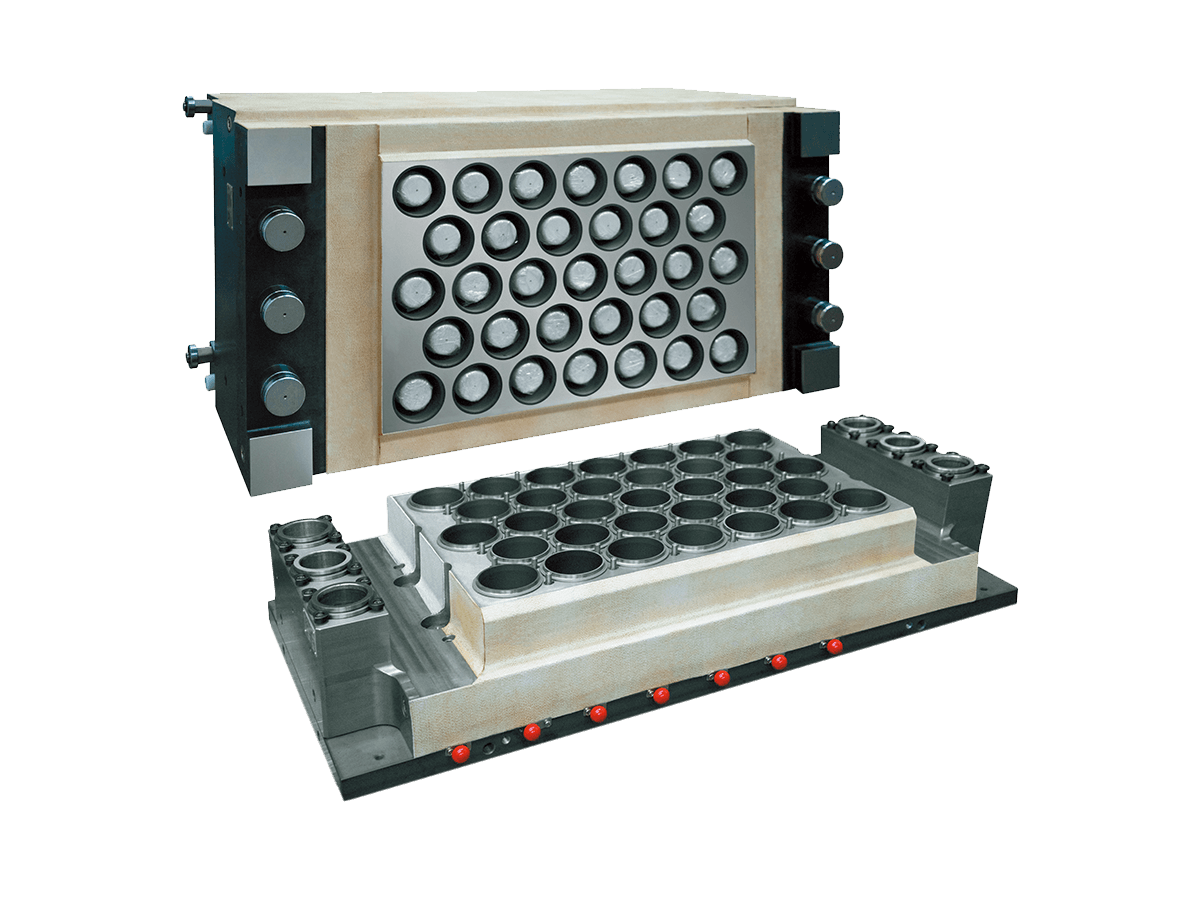
Tilting molds, also called tilt-bed molds, are used in thermoforming machines to make plastic cups. These molds adopt in-mold cutting technology, meaning the cup is formed and trimmed in a single step while still in the mold. This eliminates the need for downstream trimming equipment, reduces waste, and streamlines the production line.
Instead of ejecting cups straight upward, the mold tilts forward to release and stack them neatly. This tilting motion helps align cups more precisely during stacking, which is crucial for automated packing and consistent quality.
Tilting molds are also more cost-effective for high-volume manufacturing. They improve production speed, reduce mechanical complexity, and require less floor space, making them a smart choice for manufacturers focused on efficiency and output reliability.
Stacking Mold
A stacking mold is part of the forming mold, working in sync with the tilting mold rather than as a separate unit. Its role is to organize the finished cups into neat stacks automatically, which saves time and reduces the need for workers to handle the cups by hand.
There are different types of stacking systems, such as tilt molds that shift to let cups slide into a stack, or robotic pick-up systems that grab and arrange the cups. Some systems can also count the number of cups in each stack, which helps prepare them for packaging more efficiently.
2.3. Post-Forming Processes
Once the cups are formed, it’s time for cooling so they keep their shape and stay tough. This cooling step happens quickly, thanks to built-in systems that blow air or circulate water around the mold to solidify the plastic in seconds. Quick cooling ensures the cups don’t warp or lose detail as they set.
Then, some cups move on to the curling stage, also known as rim rolling. This optional but essential step is where the cup’s top edge is rolled outward to form a smooth, rounded rim. Curling makes the cup more comfortable to drink from, increases the structural strength at the opening, and helps snap-fit lids hold securely, especially important for beverage cups. In some production lines, especially those that store cups temporarily before curling, it may be delayed until just before packing or shipping to match custom order specs.
Finally, each batch goes through quality testing. Cups are checked for proper dimensions, wall thickness, strength, smoothness, and overall appearance. Any that show signs of cracks, warping, or inconsistent rims are removed. Only cups that pass every checkpoint move on to packaging, ready to meet industry standards and customer expectations.
2.4. Printing and Decoration
To boost branding and make cups stand out, printing and decoration come into play. This is where plain plastic turns into eye-catching, customized designs. There are a few popular techniques to get the job done.
Silk screen printing works great for bold logos and simple graphics. Offset printing steps it up for more detailed, multi-colored images, perfect when you want a polished, professional look. And for high-res images or smaller batches with a personal touch, digital printing is the go-to option.
These creative touches don’t just make the cups look good, but they turn them into mini marketing tools that carry a brand message with every sip.
2.5. Packaging and Delivery
The final step is all about getting those shiny new cups ready for the business. Once they pass inspection, the cups are counted, neatly stacked, and wrapped up, usually in plastic film or cardboard boxes, to keep them clean and safe during transit. But it doesn’t stop there.
After packaging, it’s time for distribution. Whether they’re heading to local cafés, big retail stores, or directly to customers, efficient logistics make sure the cups arrive in perfect shape, right on time. From factory floor to final destination, the whole journey is streamlined to deliver clean, sturdy, and great-looking cups every time.
3. Environmental Challenge of Making Plastic Cups
Plastic cups are widely used in everyday life due to their convenience and versatility. However, their production often involves fossil fuels and energy-intensive machinery, which can contribute to carbon emissions. After use, many plastic cups end up in landfills or as litter, where they may take hundreds of years to decompose and can gradually break down into microplastics. These microplastics may enter water systems and affect wildlife, underscoring the growing need for sustainable materials and effective recycling practices.
You may think paper cups are more eco-friendly than plastic cups, but that’s not always the case. The paper cup manufacturing process generates high temperatures, and during recycling, the inner plastic lining must be separated, which is a step that makes the process less sustainable than it seems.
Fortunately, manufacturers are now embracing sustainable innovations for making plastic cups. Some manufacturers use recycled plastics through effective closed-loop recycling systems, while others switch to bioplastics like PLA, made from corn starch, which break down more quickly under industrial composting conditions. This concern also takes effect on the production process as more companies are investing in energy-efficient machinery and renewable power to reduce emissions. These improvements don’t just benefit the planet; they also appeal to eco-conscious consumers.
Still, the road ahead isn’t easy. The industry must balance convenience with sustainability, improve recyclability, and continue innovating materials and processes to meet both environmental and consumer demands. To support this, Yi Jhih designs thermoforming molds with optimized cooling channels and precision cutting systems to help manufacturers reduce cycle times, energy consumption, and material waste.
4. Alternative Manufacturing Methods: Injection Molding
Injection molding is also a popular technique used primarily for producing plastic cups. In this method, molten plastic is injected into a precisely engineered mold to create the final shape. It’s ideal for making high-quality, consistent products with intricate designs, offering exceptional strength and long-term usability. This makes it the go-to choice for items meant to be washed and reused.
Compared to thermoforming, injection molding comes with higher tooling costs and longer cycle times, but it delivers greater design flexibility and superior durability. It’s best suited for large production runs of durable, reusable cups, where consistency and structural integrity matter. Thermoforming, on the other hand, is more cost-effective and efficient for producing lightweight, disposable cups in massive volumes.
Each method serves a different purpose: thermoforming excels in speed and simplicity, while injection molding is preferred for complex, high-strength products designed to last. For disposable cups, thermoforming remains the more cost-effective choice.
5. Plastic Cup Thermoforming Machine
Plastic cup thermoforming machines are industrial systems specifically designed to turn flat plastic sheets into shaped, functional cups. These machines are often used for making disposable drinking cups from materials like PP (polypropylene), PET (polyethylene terephthalate), PS (polystyrene), and PLA (a plant-based bioplastic). Here are the major features you’ll typically find:
- Fully Automated Operation: Modern machines handle the entire process, from feeding the raw material, heating it, forming the shape, cutting, and stacking the final product. This streamlines production and reduces labor costs.
- Touchscreen Control & PLC System: Most machines are equipped with programmable logic controllers (PLC) and user-friendly touchscreens. Operators can set precise temperatures, cycle speeds, and monitor real-time performance.
- Multi-Station Functionality: Many machines have separate stations for heating, forming, cutting, and stacking. This improves cycle efficiency and quality control, especially for high-volume runs.
- Material Flexibility: Machines can switch between different plastic materials depending on the application. This is particularly useful for manufacturers who want to offer both conventional and eco-friendly cups.
- Stacking and Counting Systems: After forming, the cups are automatically stacked and often counted for easy packaging and shipping, reducing the chance of error.
5.1. How to Choose Thermoforming Machines for Plastic Cups
Several key factors should be considered when selecting the ideal thermoforming machine for your specific needs. Here’s what to consider:
- Production Volume: High-output thermoforming machines (such as large-scale models from leading European manufacturers) are ideal for mass production. Smaller businesses can go for compact or mid-range models with slower cycle speeds but solid reliability.
- Material Compatibility: Make sure the machine works with the plastics you use. Some machines are fine-tuned for specific material thicknesses or recyclable materials.
- Automation Level: Higher automation means less manual work and smoother production, but a higher upfront cost. Look for features like robotic stacking, automatic sheet feeding, and self-diagnostic tools for better efficiency and consistency.
- Energy Efficiency: Machines with servo-driven movements, energy recovery systems, and thermal insulation save energy and reduce long-term costs.
- Footprint and Layout: Double-check the machine’s size to make sure it fits your production space. Also, consider extra room for maintenance, raw material loading, and packaging lines to keep your workflow smooth.
6. Power Your Production with Yi Jhih’s High-Performance Thermoforming Tools for Plastic Cups
Looking for high-precision plastic cup molds that work seamlessly with your thermoforming machines? Every mold we deliver is crafted using European-made precision machinery, ensuring that all critical components are as tight as 0.002mm (0.0001 inch). That means tighter seals, better forming results, and fewer production issues for your plastic cup needs.
Whether you’re running high-speed tilting systems or forming with traditional lines, our molds are engineered to meet your exacting demands.
Built for high-efficiency cup production, our tilting molds are crafted for tight cutting tolerances and top-notch alignment—ideal for ILLIG RDM, KIEFEL KTR, GABLER M-LINE, and WM F-Series machines.
Designed to match your specific product and forming conditions, our forming molds ensure repeatable performance and cost-effective production on ILLIG RDKP72, KIEFEL KMD, ASANO, and more.
From hole punching to contour punching, vertical or horizontal, our durable tools deliver precision, compatible with ILLIG, Lyle, ASANO, Chudong, and others.
For clean and accurate cuts on lids and containers, our knife-based systems offer flexibility and sharp results, perfectly suited for ILLIG RDK, KIEFEL KMD78, WM FC780, and more.
At Yi Jhih, we bring you not just thermoforming molds, but we also build lasting partnerships rooted in quality, trust, and performance. With over 50 years of experience, a dedicated team, best-in-class manufacturing practices, and millions invested in advanced precision machinery, we are fully equipped to deliver cutting-edge solutions for the food packaging industry.
Contact us today via the button below to discover how Yi Jhih’s precision thermoforming molds can elevate your plastic cup production. Our expert team is ready to assist you with custom solutions tailored to your needs.
You might also be interested in knowing more about: