What is Thermoforming: Process, Types, Materials, and More
2026-02-09
| Table of Content |
1. What is Thermoforming?
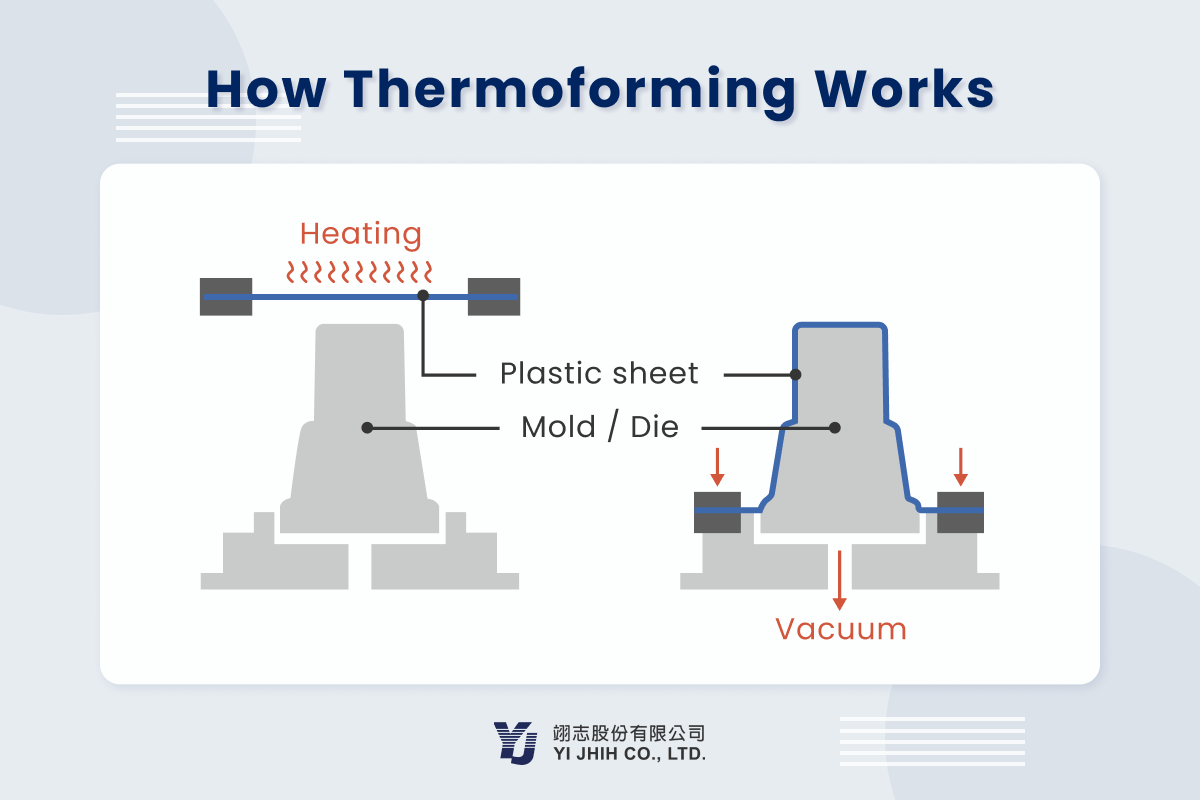
Thermoforming is an innovative plastic manufacturing process where a flat sheet of thermoplastic is heated until pliable, shaped into a three-dimensional form using a mold, and then cooled to hold its new structure. Once trimmed, the part is ready for use.
Modern thermoforming machines often combine heating, forming, and trimming into one streamlined operation, making the process efficient and cost-friendly. Its simplicity, adaptability, and reliability have made thermoforming a preferred choice for industries looking to create both prototypes and full-scale production parts.
2. Advantages of Thermoforming
2.1. Cost-Effectiveness
One of the biggest advantages of thermoforming is its affordability. Tooling costs are significantly lower compared to methods like injection molding, making it accessible even for smaller production runs. The process minimizes waste, scales easily from prototypes to large volumes, and requires less manual labor, all of which contribute to its overall cost-efficiency.
2.2. Lightweight and Durable Products
Thermoforming produces lightweight yet durable parts. This benefit is especially important in industries like automotive and aerospace, where reducing weight directly improves performance and efficiency.
Despite being lightweight, thermoformed parts are built to last. The process supports controlled material distribution and structural integrity, resulting in parts that can handle everyday use while keeping weight low. The ability to maintain strength while cutting down on weight makes thermoformed products a practical solution.
2.3. Fast Production
Thermoforming is known for its quick turnaround. Once the design and tooling are complete, forming and trimming can be completed in seconds on high-speed machines. This speed allows manufacturers to respond rapidly to market changes, launch products quickly, and keep up with customer demand without sacrificing quality.
2.4. Design Flexibility
Creativity thrives with thermoforming. The process allows for intricate shapes, complex contours, and detailed textures that might be costly or difficult with other methods. Designers can develop custom products with unique dimensions and features, opening up possibilities for innovation and product differentiation.
2.5. Sustainability
Thermoforming supports eco-friendly goals through its efficient use of materials and energy. The process generates minimal waste, and excess plastic can often be recycled directly back into production. Many thermoformed products are recyclable themselves, and manufacturers can incorporate recycled content into new parts. With lower energy demands than some alternatives, thermoforming also reduces carbon footprint and operating costs.
3. How Thermoforming Works: Basic Process
3.1. Designing
The process begins with designing the part, usually with CAD (Computer-Aided Design) software. At this stage, every detail is considered, from the functional requirements to the overall look of the product. Thermoforming offers incredible flexibility in design for food packaging and other applications, allowing engineers to include complex curves, undercuts, and even detailed textures. It might start with brainstorming and competitive research, which then evolve into sketches, realistic renderings, and prototypes for customer review.
3.2. Selecting Materials
Next comes selecting the right material. This step is crucial because the type of plastic chosen will directly affect the durability, flexibility, transparency, chemical resistance, and even heat resistance of the final part. Thermoforming works with a wide range of thermoplastics, so manufacturers can tailor the choice to match the product’s intended use and budget.
3.3. Heating
Once the material is chosen, it moves on to heating. The plastic sheet is warmed until it becomes pliable, but this isn’t as simple as it sounds; achieving even temperature across the sheet is vital.
Uneven heating can lead to weak spots or inconsistencies in the final part. Depending on the material and thickness, heating might be done with radiant heaters, infrared heaters, or convection ovens.
3.4. Forming
With the sheet now soft and flexible, the process enters the forming stage. The heated plastic is moved over or into a mold, often made of aluminum, and external forces are applied to stretch the sheet and press it against every detail of the mold.
This is the moment when the sheet transforms from a flat piece of plastic into a functional product. There are several ways to apply that force, vacuum, pressure, mechanical plugs, or even billow, and we’ll explore those specific forming methods in the next section.
3.5. Cooling/Trimming
Finally, the new shape must be locked in place through cooling and trimming. Rapid and uniform cooling prevents the plastic from warping and ensures dimensional accuracy. Air cooling, water cooling, or dedicated cooling fixtures may be used.
Once the part has solidified, excess plastic around the edges is trimmed away. Many modern machines handle trimming automatically, while others may use separate die-cutting or laser cutting systems for extra precision. At this point, the product may be finished, or it may move on to additional steps like labeling, assembly, or packaging.
4. Types of Thermoforming Methods
4.1. Vacuum Forming
Vacuum forming is one of the simplest and most widely used thermoforming methods. A flat plastic sheet is heated until it becomes soft, then a vacuum pump removes the air between the mold and the sheet. This forces the plastic tightly against the mold surface. Once the sheet cools, it holds its new shape and is trimmed into the finished product.
The reason vacuum forming is so popular is its speed and affordability. Tooling is inexpensive, setup is straightforward, and it’s well-suited for high-volume production. While it doesn’t capture extremely sharp details, it delivers durable products quickly. That makes it ideal for disposable food containers, blister packs, trays, automotive prototypes, and other everyday items where precision isn’t the highest priority.
4.2. Pressure Forming
Pressure forming begins much like vacuum forming, but with one major difference. After the air is pulled out to press the sheet against the mold, compressed air is applied on top of the plastic.
This extra pressure pushes the softened sheet deeper into the mold, allowing it to capture fine textures and sharp edges that vacuum forming alone cannot achieve. The result is a more refined, high-quality finish that can resemble injection-molded parts in appearance.
This method stands out for products where detail, durability, and aesthetics matter. You’ll find pressure-formed parts in medical device housings, consumer electronics casings, and automotive interiors.
4.3. Twin Sheet Forming
Twin sheet forming is all about strength and functionality. In this process, two separate plastic sheets are heated at the same time, and each is shaped against its own mold. The softened sheets are then pressed together at the edges, often with air pressure injected between them to improve bonding. The result is a hollow or double-walled product that is both strong and lightweight.
This method is ideal for replacing heavier materials like metal, as it offers durability without added weight. Twin sheet forming is commonly used to create air ducts, large storage containers, pallets, kayaks, and even fuel tanks. If you need a product that can handle demanding conditions while remaining light, this technique is the go-to choice.
4.4. Mechanical Forming
Mechanical forming relies on direct force to shape plastic with accuracy. A preheated sheet is placed over a mold, and a mechanical plug, often called a core plug, physically pushes the sheet into the cavity. This extra control ensures even material distribution and prevents thinning in deep areas.
Unlike vacuum or pressure alone, the mechanical force allows for sharper details and more precise geometries. It’s often combined with other forming methods when both detail and consistency are critical. Because of this precision, mechanical forming is favored for complex parts like dashboard panels, medical device casings, and construction components where strength, accuracy, and durability all matter.
4.5. Drape Forming
Drape forming is as straightforward as it sounds. A heated sheet is softened and then draped over a mold, usually a mandrel, to take on its shape. Gravity and light pressure do most of the work, and once cooled, the form is set. This is one of the most affordable thermoforming techniques because it requires minimal tooling and setup.
Although it does not capture fine surface detail, it maintains the sheet’s thickness better than many other methods, avoiding weak spots. Drape forming is well-suited for large, simple, curved designs such as aircraft windshields, display covers, furniture components, and architectural panels. It’s the practical choice when the goal is simplicity and cost control.
4.6. Billow Forming
Billow forming takes a very different approach compared to mold-based processes. Here, the heated plastic sheet is inflated with air pressure to form a bubble. Because no mold is used, the surface remains perfectly smooth and free from tool marks. The shape is controlled by adjusting the airflow and sheet temperature until the desired bubble-like form is achieved.
This technique is particularly useful for creating large, rounded, symmetrical parts. While more expensive than simpler methods, billow forming offers unmatched freedom for smooth, dome-like designs. Skylights, domes, lighting covers, and rounded displays are common products that come from this process.
4.7. Matched Mold Forming
When products demand the highest level of precision, matched mold forming is the method of choice. A heated plastic sheet is placed between a male and female mold, and both molds press together to shape the sheet with exact tolerances.
This dual-mold system ensures consistent thickness, sharp detail, and durable structure. Because the tooling is more complex, matched mold forming is considered one of the more expensive thermoforming options.
However, the trade-off is superior accuracy and reliability, which is critical for applications such as automotive trim, durable fixtures, and medical device housings. It’s the technique that manufacturers turn to when there is no room for compromise on quality.
| Method | Speed | Cost | Detail / Accuracy | Key Strength | Best For |
|---|---|---|---|---|---|
| Vacuum Forming | Fast | Low | Basic detail | Simple, economical forming | Disposable food containers, trays, blister packs, prototypes |
| Pressure Forming | Moderate | Moderate | High detail, sharp edges | Injection-molding-like appearance | Medical housings, electronics, automotive panels |
| Twin Sheet Forming | Moderate | High | Strong structural form | Lightweight, hollow structures | Pallets, tanks, ducts, kayaks, protective cases |
| Mechanical Forming | Moderate | Higher | Very high precision | Even material distribution | Dashboard panels, medical casings, structural parts |
| Drape Forming | Fast | Very low | Low detail | Large smooth curves | Aircraft windows, domes, furniture panels |
| Billow Forming | Moderate | Moderate-High | Smooth surface | Seamless rounded shapes | Skylights, domes, lighting covers |
| Matched Mold Forming | Slow | High | Highest precision | Tight tolerances | Automotive trim, medical, industrial components |
5. Common Materials for Thermoforming Plastics
The choice of thermoforming plastics depends on factors such as durability, flexibility, chemical resistance, clarity, recyclability, and cost. Below are some of the most commonly used materials in thermoforming.
5.1. ABS (Acrylonitrile Butadiene Styrene)
ABS is a tough, rigid plastic known for its excellent balance of impact strength, heat resistance, and dimensional stability.
It withstands repeated stress without cracking and resists abrasion, making it durable in rough environments. ABS performs reliably in temperatures ranging from -20°C to 80°C and can be formulated to meet UL flammability ratings. It also has good chemical resistance to acids and alkalis, but is less resistant to strong solvents.
With its machinability and paintable surface, ABS is a favorite for automotive interiors such as dashboards and door panels, protective helmets, electronic housings, piping systems, and consumer products where both strength and aesthetics matter.
5.2. PVC (Polyvinyl Chloride)
PVC stands out for its versatility, as it can be rigid or flexible depending on formulation. Rigid PVC has high hardness, tensile strength, and chemical resistance, while flexible PVC includes plasticizers that make it bendable and elastic. Both types resist moisture, grease, and most acids, making them reliable for industrial and consumer use.
PVC is inherently flame-retardant and electrically insulating, although it can degrade under prolonged UV exposure if not stabilized. It is widely used in construction (pipes, window frames, flooring), medical tubing, blister packs, wire insulation, signage, and automotive parts. While strong against many chemicals, PVC is less stable against aromatic hydrocarbons and solvents containing chlorine.
5.3. PET (Polyethylene Terephthalate)
PET is known for its excellent clarity, toughness, and lightweight nature. It has high tensile strength and resists impact, making it durable in thin-walled packaging. Its strong barrier properties against oxygen, carbon dioxide, and moisture help extend product shelf life, which is why it’s a top choice for food and beverage containers.
PET is also chemically stable, resistant to dilute acids, oils, and alcohols, though it can be sensitive to bases. It is recyclable and used widely in bottles, clamshell packaging, and fibers for textiles. Its transparency makes it attractive for retail packaging, while its recyclability contributes to circular economy goals.
5.4. PETG (Polyethylene Terephthalate Glycol)
PETG is a modified form of PET that incorporates glycol for added toughness and formability. Unlike PET, it does not crystallize during heating, which makes it easier to form into complex shapes without cracking. PETG combines high clarity with impact resistance and good chemical resistance, especially to acids and alcohols.
It is also less brittle than standard PET, making it ideal for deep draws and intricate packaging. PETG is commonly used for medical trays, blister packs, retail clamshells, signage, and displays that require both strength and transparency. Its ease of thermoforming makes it popular for prototypes and custom packaging designs.
5.5. PS/HIPS (Polystyrene/High Impact Polystyrene)
Polystyrene is a lightweight, rigid plastic with good optical clarity and low cost, making it a staple in packaging. It has moderate impact resistance but can be brittle under stress unless modified. Its insulating properties make it useful for food containers, while its ease of molding and printing capability make it attractive for retail products.
However, standard PS has limited resistance to UV and many solvents. High Impact Polystyrene (HIPS) solves this by blending polystyrene with rubber, improving toughness, durability, and shock absorption.
PS and HIPS are found in disposable food trays, CD cases, yogurt cups, countertop displays, and picture frames. While not the easiest material to recycle, its affordability and versatility keep it in wide use.
5.6. PP (Polypropylene)
Polypropylene is one of the most commonly used plastics in thermoforming thanks to its low density, toughness, and excellent resistance to chemicals, including acids, alkalis, and solvents. It is lightweight yet strong, with excellent fatigue resistance, meaning it can be bent repeatedly without breaking.
PP withstands temperatures up to 120°C, making it suitable for hot-fill food packaging and sterilizable medical devices. It also resists moisture absorption, making it an excellent choice for storage containers and automotive parts. Its semi-crystalline structure contributes to its strength and durability, though it can become brittle at very low temperatures.
PP is widely used in toys, packaging, ventilators, piping, automotive panels, and household containers.
5.7. Polycarbonate (PC)
Polycarbonate is a high-performance plastic known for optical clarity, extreme toughness, and heat resistance. It can transmit up to 90% of visible light, almost like glass, while being 250 times stronger, making it shatterproof.
PC maintains stability across a wide temperature range, resists flame, and has excellent electrical insulation properties. Its chemical resistance is good, though it is vulnerable to alkalis and certain solvents.
Because it can deform without cracking, PC is ideal for safety helmets, bulletproof glass, machine guards, medical devices, and automotive headlights. Its durability makes it a premium choice for applications where safety and clarity are crucial.
5.8. Polyethylene (LDPE and HDPE)
Polyethylene is the most widely produced plastic, available in several grades. Low-Density Polyethylene (LDPE) is flexible, lightweight, and resilient, with strong resistance to moisture and chemicals. It has a waxy feel and is widely used in films, squeeze bottles, cable insulation, and frozen food packaging.
High-Density Polyethylene (HDPE), on the other hand, is rigid, tough, and has a high strength-to-density ratio. It resists many chemicals and withstands outdoor conditions better than LDPE. HDPE is used in blow-molded containers, fuel tanks, piping, hard hats, and storage bins.
Both LDPE and HDPE are recyclable, though HDPE tends to be favored for structural and heavy-duty products.
5.9. PMMA (Polymethyl Methacrylate)
Also known as acrylic glass, PMMA is prized for its exceptional clarity and ability to transmit light almost as well as glass. It resists UV radiation, weathering, and impact better than glass, making it a durable choice for outdoor applications. PMMA is also lightweight, scratch-resistant, and available in multiple colors.
While it is more brittle than polycarbonate, it offers superior resistance to yellowing under sunlight. PMMA is commonly used in aquariums, lenses, headlamps, skylights, displays, and architectural panels where transparency and aesthetics are important.
5.10. Cellulose Acetate
Cellulose acetate is an eco-friendly thermoplastic derived from renewable sources like wood pulp and cotton. It is transparent, glossy, and flexible, with good resistance to impact and wear. Its biodegradability makes it attractive for sustainable products. However, it has lower heat resistance compared to other plastics.
Cellulose acetate is commonly used for film, eyeglass frames, pill coatings, packaging, and tool handles. Its renewable origins make it a greener alternative for industries seeking more sustainable options.
5.11. Acrylic
Acrylic is a versatile and durable plastic with excellent transparency and weather resistance. It is stronger and more impact-resistant than glass, while still being lightweight and easy to shape.
Acrylic can be polished to a crystal-clear finish and is available in a wide range of colors. Its resistance to UV and weathering makes it ideal for signage, displays, skylights, and windows.
Acrylic is also widely used in consumer goods, automotive parts, and housings for electronic equipment. Its combination of clarity, toughness, and affordability makes it a staple in both decorative and functional applications.
| Material | Features | Common Uses | Pros | Cons |
|---|---|---|---|---|
| ABS (Acrylonitrile Butadiene Styrene) | Strong, rigid, impact and abrasion resistant; performs in -20°C to 80°C; paintable | Automotive interiors, appliances, piping, protective gear, consumer goods | Durable, machinable, good surface finish, UL flammability options | Sensitive to strong solvents, less UV resistant |
| PVC (Polyvinyl Chloride) | Can be rigid or flexible; good chemical resistance; flame-retardant; electrical insulator | Pipes, medical tubing, blister packs, window frames, signage, automotive interiors | Versatile, durable, resistant to moisture and grease, cost-effective | UV degradation without stabilizers; reacts with some solvents |
| PET (Polyethylene Terephthalate) | Clear, tough, high tensile strength, excellent moisture and gas barrier; recyclable | Bottles, food packaging, clamshells, fibers, personal care containers | Lightweight, recyclable, excellent clarity, strong barrier | Requires drying after forming; limited alkali resistance |
| PETG (Polyethylene Terephthalate Glycol) | Clear like PET but more flexible; impact and chemical resistant | Displays, clamshells, blister packs, medical trays | Easy to form, less brittle, good for deep draws | Less heat resistant than PET; scratches more easily |
| PS (Polystyrene) | Clear, rigid, lightweight, insulating; HIPS variant is tougher and printable | Disposable trays, food containers, jewel cases, retail displays | Low cost, easy to mold, printable, insulating | Brittle unless modified; poor UV and solvent resistance; harder to recycle |
| PP (Polypropylene) | Lightweight, tough, fatigue resistant, chemical and moisture resistant; heat resistant up to ~120°C | Medical devices, packaging, containers, toys, automotive parts | Affordable, excellent chemical resistance, reusable, low density | Can become brittle at low temperatures; difficult to bond without treatment |
| PC (Polycarbonate) | Optically clear (90% light transmission), impact resistant, flame-retardant, heat resistant | Safety gear, eyewear lenses, medical devices, headlights | Shatter resistant, strong, high clarity, electrical insulator | Sensitive to alkalis and solvents; more expensive |
| LDPE (Low Density Polyethylene) | Flexible, lightweight, moisture and chemical resistant, UV resistant | Films, food packaging, squeeze bottles, cable insulation | Flexible, strong barrier, affordable, recyclable | Lower strength; poor temperature resistance |
| HDPE (High Density Polyethylene) | Rigid, durable, high strength to density ratio, chemical and UV resistant | Hard hats, pipes, outdoor furniture, storage containers | Strong, lightweight, weather resistant, recyclable | Less flexible; limited transparency |
| PMMA (Polymethyl Methacrylate) | Glass-like clarity, UV and weather resistant, scratch resistant | Headlamps, aquariums, signage, skylights | High transparency, good outdoor durability, lighter than glass | More brittle than PC; limited chemical resistance |
| Cellulose Acetate | Renewable, transparent, glossy, impact resistant | Films, eyeglass frames, pill coatings, tool handles | Biodegradable, renewable source | Lower heat resistance; less durable for heavy duty use |
| Acrylic | Transparent, durable, shatter resistant, UV resistant | Signs, displays, windows, automotive parts, housings | Excellent clarity, affordable, weatherproof | More brittle than PC; scratches easily |
5.12. Heavy Gauge vs. Thin Gauge Thermoforming
Thermoforming can be divided into two categories depending on the thickness of the plastic sheet.
Thin-gauge thermoforming uses sheets under 3 mm thick, typically roll-fed into the machine. It is best for producing high-volume disposable products like packaging, cups, trays, and medical containers, and it uses materials such as PET, PETG, and PVC.
Heavy gauge thermoforming, on the other hand, uses sheets between 1.5 mm and 9.5 mm thick, usually fed as cut sheets. It is slower and more suited for lower-volume production but produces robust and durable products such as automotive interiors, structural components, pallets, shower trays, and luggage. Materials like ABS, HDPE, and PP are commonly used in heavy-gauge processes.
| Category | Thickness | Materials Used | Best For |
|---|---|---|---|
| Thin Gauge | < 3 mm | PET, PETG, PVC | Disposable packaging, trays, medical containers |
| Heavy Gauge | 1.5–9.5 mm | ABS, HDPE, PP | Automotive parts, enclosures, structural components |
6. What is Thermoforming Used for?
The thermoforming process can be adapted to create both small, detailed parts and large, functional components across countless industries. Let’s look at some of the common thermoforming products from different fields:
6.1. Food Packaging
Food packaging is perhaps the most visible application of thermoforming. It is used to make trays, blister packs, clamshells, single-use containers, disposable cups, plates, and even bottles for beverages. Thermoforming works well here because it provides food-safe materials, outstanding clarity to showcase products, and design flexibility for branding.
Lightweight packaging reduces transport and handling costs, while features like tamper-resistant seals and leak-proof designs extend shelf life and improve safety. The ability to use recyclable materials such as PET and PP, or to incorporate post-consumer recycled content, also makes thermoformed packaging a sustainable option.
Read More:
6.2. Automotive Industry
In the automotive world, thermoforming is used for both interior and exterior components. Dashboards, door panels, trim pieces, bumpers, spoilers, fenders, and armrests are all frequently produced with this method. Recreational vehicles and specialty cars also rely on thermoformed panels and fixtures.
The appeal lies in producing parts that are lightweight yet durable, which helps improve fuel efficiency while maintaining structural integrity. Thermoforming also allows manufacturers to deliver refined finishes and stylish designs at a competitive cost.
6.3. Medical Equipment and Healthcare
Thermoforming plays an essential role in the healthcare industry, where precision, safety, and customization are non-negotiable. It is used for enclosures, trays, housings for diagnostic devices, sterile packaging, and surgical instrument trays. More specialized uses include hearing aids, ventilator parts, hospital bed components, and even custom prosthetics and orthotics.
Thermoforming materials can be sterilized, are lightweight for ease of handling, and provide strong barriers against contamination. This combination makes thermoforming a trusted process in medical manufacturing.
6.4. Consumer Goods
For consumer products, thermoforming is a cost-effective way to keep up with fast-changing market demands. It is used in retail displays, point-of-sale signage, casings for electronics, and household appliances such as refrigerator trays and bathtub liners. It also appears in toys, protective sports equipment, and furniture components.
One of the biggest advantages here is speed—thermoforming enables manufacturers to respond quickly to customer preferences, producing goods with detailed designs and tight tolerances without long lead times.
6.5. Industrial Equipment
Industries that require rugged, long-lasting parts also turn to thermoforming. Pallets, protective covers, structural panels, and agricultural equipment components such as tractor interiors, sprayer shells, and feed containers are often thermoformed. Acoustic panels and transparent skylights are other examples. The process allows for the production of robust, heavy-duty items that stand up to demanding environments, offering both durability and practicality.
6.6. Electrical and Electronic Devices
Thermoforming is widely used in electronics for making enclosures, housings, and protective cases. Products like ATM covers, computer housings, switch boxes, control panels, refrigeration liners, and lenses benefit from the process.
Materials such as polycarbonate are especially valued here for their optical clarity, heat resistance, and strength, making them ideal for protective covers, light lenses, and precision components.
6.7. Aerospace and Defense
Weight is everything in aerospace, and thermoforming delivers significant savings. Aircraft interiors, seats, control panels, windows, UAV components, and protective enclosures are all made with thermoformed plastics. These parts are lightweight yet strong, helping improve fuel efficiency without compromising safety or performance. In defense, thermoformed parts also provide durability for equipment that must perform under extreme conditions.
6.8. Construction, HVAC, and Plumbing
Finally, thermoforming supports construction and infrastructure through the production of pipes, window frames, bathtubs, shower enclosures, and corrosion-resistant piping. Materials like PVC and HDPE are especially valued for their chemical resistance, rigidity, and long-term durability. These properties make them ideal for building components that need to withstand heavy use and harsh environments.
7. Thermoforming Equipment and Machines
Thermoforming equipment ranges from industrial-scale systems designed for large production runs to compact desktop models suited for prototyping and creative projects. Here are the most common types of machines used today.
7.1. Industrial Thermoforming Equipment
Industrial thermoforming machines are built for serious production. They handle medium to high volumes, offering large forming areas and the ability to create deep draws with strong vacuum or pressure forces. These machines can process a wide variety of materials and sheet thicknesses, making them extremely versatile for industries like packaging, automotive, or medical devices.
Most models are highly automated, featuring advanced controls, precision heating, and even rapid tool-changing systems to minimize downtime. Industrial machines are a significant investment, but they deliver the speed, efficiency, and consistency needed for large-scale manufacturing.
7.2. Desktop Thermoforming Equipment
For smaller-scale projects, desktop thermoforming machines provide an accessible solution. These compact systems are designed for prototyping, custom parts, or low-volume runs, making them popular with product designers, startups, and even educators. They typically have smaller forming areas, limited draw depths, and lower vacuum or pressure forces compared to industrial models. Many operate manually or with semi-automation, which keeps costs lower.
7.3. DIY Thermoforming Equipment
At the most basic level, DIY thermoforming setups give hobbyists and beginners a chance to experiment without breaking the bank. These systems are usually homemade or very simple commercial kits that rely on manual heating and vacuuming. They are useful for learning the process or creating one-off items, but come with limitations.
Forming areas are extremely small, precision is minimal, and production is labor-intensive. While budget-friendly, DIY setups aren’t suitable for professional use or for producing high-quality, repeatable parts. Instead, they serve as an entry point into the world of thermoforming for those who want to understand the basics hands-on.
8. Yi Jhih – Your Top Choice for Thermoforming Mold Manufacturer
Thermoforming brings together design flexibility, material variety, and cost efficiency to create everything from everyday food packaging to complex industrial components. Its advantages, lightweight durability, fast production, and sustainability, have made it a trusted solution across industries worldwide. But to unlock its full potential, precision molds are essential. This is where you find: Yi Jhih
Every mold for food packaging we deliver is crafted with European-made precision machinery, achieving tolerances as tight as 0.002 mm (0.0001 inch). This results in more accurate forming, cleaner cutting performance, and fewer production issues across high-speed lines, sharper forming, and fewer production issues for your cups, trays, and containers. Whether you run high-speed tilting systems or conventional forming lines, our molds are built to perform exactly the way your process demands.
Engineered for high-efficiency cup production, our tilting molds deliver flawless alignment and tight cutting tolerances. They are a perfect fit for ILLIG RDM, KIEFEL KTR, GABLER M-LINE, and WM F-Series machines, ensuring maximum output with minimal downtime.
Customized to your product specifications and forming conditions, our forming molds guarantee repeatable performance and cost-efficient production. They are designed for compatibility with ILLIG RDKP72, KIEFEL KMD, ASANO, and more.
From hole punching to complex contour punching—whether vertical or horizontal—our tools deliver precision and longevity. They work seamlessly with ILLIG, Lyle, ASANO, Chudong, and many other systems.
For clean, accurate cuts on lids and containers, our steel rule knife systems provide flexibility and sharp results. They are ideal for ILLIG RDK, KIEFEL KMD78, WM FC780, and beyond.
At Yi Jhih, we don’t just manufacture molds—we build lasting partnerships. With over 50 years of expertise, millions invested in advanced machinery, and a team dedicated to innovation, we are ready to support the growing demands of the food packaging industry. When precision, reliability, and performance matter, Yi Jhih is the partner you can trust.
You might also be interested in knowing more about: